To understand why you need a specialized tool, you first need to understand what generic AI actually does. Tools like ChatGPT are “probabilistic text predictors.” They are trained on the entire internet to predict the next plausible word in a sentence. This makes them incredibly fluent. They sound professional, confident, and articulate.
But fluency is not competence. In procurement, “sounding” right isn’t enough; the data must be right.
The “Hallucination” Risk in Sourcing
If you ask a general AI to “Compare these two bids,” it might misinterpret a unit of measure because it lacks deep domain knowledge. It might see “1000m cabling” and “1km cabling” and fail to mathematically align them if the context is buried in a header. Worse, if it doesn’t know the answer, it might guess, a phenomenon known as “hallucination.” In creative writing, a hallucination is imagination. In an AI RFQ tool, a hallucination is a budget overrun.
The “Execution” Gap
Procurement is a workflow, not just a text generation task.
ChatGPT: Can draft an email to a supplier.
The Gap:You still have to copy that text into Outlook, attach the files, find the supplier’s email address, hit send, set a reminder to follow up, and manually save the response when it comes in.
AI RFQ Tool: Drafts the email, pulls the correct contact from your vendor database, sends the invite, automatically chases the vendor if they don’t reply by day 3, and auto-files the response into a secure dashboard.
This is the difference between Passive AI (Chat) and Agentic AI (Action).
What is a Purpose-Built AI RFQ Tool?
A purpose-built AI RFQ tool is a sourcing platform that integrates artificial intelligence into the execution layer of procurement. It combines the natural language capabilities of LLMs with structured databases, workflow automation, and strict logic gates.
It is designed to handle the “Three Vs” of procurement data that generic AI struggles with:
Volume: Processing hundreds of line items across dozens of vendors.
Variety: Reading emails, PDFs, Excels, and Word docs simultaneously.
Validity: Ensuring the data extracted is accurate and legally binding.
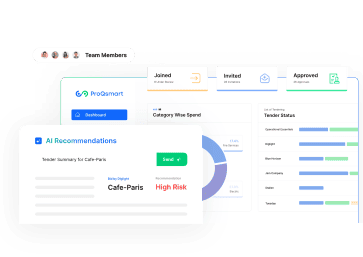
ProQsmart is a prime example of this category. It doesn’t just “chat” with you; it acts as an intelligence layer that sits between your messy communication channels (email, files) and your rigid ERP system.
4 Reasons You Need a Specialized AI RFP Tool
If you are evaluating whether to stick with manual processes supplemented by ChatGPT or to invest in a dedicated platform, consider these four critical differentiators.
1. Semantic Intelligence vs. Keyword Guessing
Generic AI treats procurement terms as just words. A specialized AI RFQ tool utilizes “Semantic Intelligence.” It understands the meaning behind the jargon.
In the construction industry, for example, “Mobilization” is a specific cost code with legal implications, not just a verb meaning “to move.” ProQsmart’s AI is trained on procurement-specific datasets. It knows that:
“FOB” determines liability, not just shipping cost.
“500HP Motor” and “Drive Unit, 500 Horsepower” are identical items for comparison purposes.
A “scope gap” isn’t just missing text; it’s a financial risk.
This context allows the tool to perform tasks like Automatic Bid Comparison with high accuracy. It can map messy vendor descriptions to your standard material codes automatically, a task that would confuse a general-purpose bot.
2. Institutional Memory: The “Vector Database” Advantage
One of the biggest frustrations with tools like ChatGPT is that they have “amnesia.” Every new chat session starts from zero. They don’t know what you bought last year or what Vendor A quoted for this same item six months ago.
A purpose-built AI RFP tool utilizes a Vector Database to build “Institutional Memory.”
Bench marking: When a new bid comes in, the tool instantly compares it against 5 years of your historical data. It can flag, “This price is 12% higher than what we paid last May.”
Supplier Capabilities: It remembers that “Acme Corp” usually bids on electrical parts, even if you forgot.
Contextual Retrieval: It allows you to ask, “Show me the last 3 times we bought laptops and who won,” and retrieves accurate financial data, not a hallucinated summary.
3. Agentic Automation: The AI That “Does”
The true ROI of AI in procurement comes from removing manual touchpoints. This requires Agentic AI—autonomous agents that can execute workflows.
In a dedicated AI RFQ tool, the workflow looks like this:
Ingest: You forward an email request from an engineer to the AI.
Structure: The AI reads the email, extracts the requirements, and creates a draft RFQ.
Discovery: The AI looks at your vendor database and suggests, “Based on these items, we recommend inviting these 5 suppliers.”
Outreach: You click “Approve,” and the AI sends personalized invites to all vendors.
Chasing: The AI monitors the deadline. If Vendor C hasn’t opened the email 24 hours before the deadline, the AI sends a polite reminder, without you lifting a finger.
This “Invisible Intake” and autonomous execution reduces the administrative burden by over 65%, something a chatbot simply cannot do.
4. Security and Compliance (The “Public Cloud” Problem)
This is perhaps the most critical factor for enterprise procurement.
The Risk: When you paste a vendor’s confidential price list or your internal strategy document into a public version of ChatGPT to “summarize” it, you may be feeding that data into a public model. This is a massive compliance breach.
The Solution: Purpose-built AI RFQ tools like ProQsmart are built on secure, private infrastructure (SOC2 certified). Data is encrypted, isolated, and never used to train public models.
Audit Trails: In a sourcing event, you need to prove why you chose a vendor. A chat log is not an audit trail. A specialized tool records every bid, every revision, every email open, and every scoring decision, providing a watertight defense for audits.
The Use Case: “The 2-Minute RFQ”
Let’s look at how this comes together in a real-world scenario that generic AI cannot handle.
Scenario: An Operations Manager emails you: “Need 50 new office chairs and 20 standing desks for the new wing. Budget is $15k. Need them by end of month.”
With Generic AI: You copy the email into ChatGPT and say “Write an RFQ for chairs.” It gives you a text template. You copy that into Word. You fix the formatting. You open Outlook. You find vendor emails. You attach the Word doc. You send 5 emails. You wait. You get 5 replies (some PDF, some Excel). You copy-paste prices into Excel. You calculate the total.
With a Purpose-Built AI RFQ Tool: You forward the Operations Manager’s email to bu*@*******rt.com.
Auto-Creation: The tool intercepts the email, recognizes the intent, and creates a draft RFQ event.
Smart Suggestions: It identifies the category “Office Furniture” and auto-populates 4 preferred vendors you’ve used before.
One-Click Launch: You review the draft on your phone and click “Launch.”
Auto-Analysis: As bids come in, the tool extracts the prices and updates a live comparison dashboard.
Decision: You see a “Best Value” flag on Vendor B and click “Award.”
The result is the same outcome, but the AI RFQ tool reduced the process from 2 hours of admin to 2 minutes of review.
Conclusion: Stop Chatting, Start Sourcing
The allure of generic AI is strong because it is accessible and often free. But in a high-stakes function like procurement, “free” comes with hidden costs: security risks, manual data wrangling, and a lack of accountability.
To truly transform procurement, you need to move beyond tools that just generate text to platforms that generate results. A purpose-built AI RFQ tool or AI RFP tool brings the context, security, and execution power needed to turn the chaos of sourcing into a strategic advantage. It allows your team to stop acting like data entry clerks and start acting like strategic negotiators.
The future of procurement isn’t a chatbot; it’s an intelligent engine that works alongside you.
FAQs
1. What is the difference between an AI RFQ tool and a standard e-sourcing tool?
Standard e-sourcing tools are digital forms; they require you to manually input data and set up events. An AI RFQ tool is agentic; it can read unstructured data (emails, PDFs), automatically set up events, chase vendors, and analyze complex bids without manual intervention, significantly reducing the workload.
2. Can I just use ChatGPT to compare vendor bids?
It is not recommended. ChatGPT lacks specific domain context, meaning it may misinterpret units of measure or incoterms. More importantly, pasting confidential vendor pricing into a public LLM can be a security violation. Specialized AI RFQ tools are secure (SOC2) and use specific algorithms to ensure mathematical accuracy.
3. Does an AI RFP tool work for services, or just goods?
It works for both. While goods (like hardware) are easier to compare on price, advanced AI RFP tools can analyze qualitative responses for services. They can score written answers against your criteria, highlighting strengths and weaknesses in long-form proposals for services like IT consulting or construction.
4. How does the AI handle messy vendor attachments?
Purpose-built tools use “Document Intelligence” (OCR + NLP) trained on procurement documents. They can extract structured data from scanned PDFs, messy Excel files, and Word documents, mapping them to your required format automatically.
5. Is my data safe in an AI procurement tool?
Yes, if you choose a purpose-built enterprise solution. Look for platforms that are SOC2 Type II certified. Unlike public AI models, these tools ensure your data is encrypted, isolated, and never used to train the general model accessed by other companies.
6. Will an AI RFQ tool replace buyers?
No. It replaces the administration of buying. The AI handles the “grunt work”, data entry, email chasing, and basic comparison. This frees up the human buyer to focus on strategy, relationship building, complex negotiation, and final decision-making.
7. How long does it take to implement an AI RFQ tool?
Because modern AI RFQ tools focus on “Invisible Intake” (email-based workflows) and web-based portals, implementation is rapid. “Lite” versions can often be deployed in less than a week, while full enterprise integrations with ERPs might take 4-12 weeks depending on complexity.