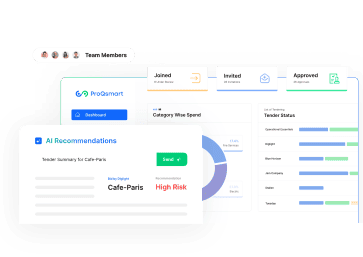
AI for supplier response comparison is the application of artificial intelligence to automatically extract, structure, and analyze bid data from diverse vendor documents (PDFs, Excels, emails). By replacing manual data entry with intelligent automation, this technology enables procurement teams to instantly visualize side-by-side comparisons, detect scope gaps, and identify the best commercial value across hundreds of line items in minutes rather than days.
For decades, the “Comparison Matrix” has been the bane of the procurement profession. Whether you call it a bid leveling sheet, a commercial evaluation, or simply “the spreadsheet,” the process is identical: open a vendor’s PDF, find the price, type it into Excel, repeat 500 times. This manual workflow is not just slow; it is a breeding ground for errors that lead to bad decisions. AI for supplier response comparison transforms this static, labor-intensive task into a dynamic, strategic advantage.
The Problem: Why Manual Response Comparison fails
Before understanding the solution, we must acknowledge the severity of the problem. In complex categories like construction, manufacturing, and logistics, supplier responses are rarely standardized.
Data Fragmentation: Vendor A quotes a lump sum. Vendor B breaks it down by unit. Vendor C uses a completely different currency.
The “Copy-Paste” Trap: A typical mid-sized project might involve 4-5 bidders and a Bill of Quantities (BOQ) with 300 line items. That is 1,500 individual data points that a human must manually locate, verify, and transcribe.
Hidden Risks: When you are buried in data entry, you miss the nuance. You might miss that the lowest bidder excluded “freight” or “installation,” making them artificially cheap.
Implementing AI for supplier response comparison eliminates this friction. It acts as a universal translator, turning the chaos of disparate vendor files into a unified, decision-ready dashboard.
How Does AI for Supplier Response Comparison Work?
The term “AI” is often thrown around loosely, but in the context of bid comparison, it refers to specific, purpose-built technologies: Optical Character Recognition (OCR), Natural Language Processing (NLP), and Semantic Intelligence.
Here is the step-by-step workflow of a modern AI comparison engine:
1. Ingestion and Extraction
The process begins when you receive a quote. Instead of opening it and typing, you simply upload the file, whether it is a scanned PDF, a complex Excel sheet, or a Word document, into the platform. The AI scans the document, identifying the geometric structure of tables to distinguish between headers, line items, and footers.
2. Semantic Item Matching
This is where the “Intelligence” shines. A common challenge is that suppliers describe the same item differently.
RFQ: “500GB SSD Hard Drive”
Vendor A: “Solid State Drive, 500 Gigabytes”
Vendor B: “SSD-500-SATA”
A standard keyword search would fail to link these. However, AI for supplier response comparison uses semantic matching to understand that these are identical products. It automatically aligns them in the same row of your comparison matrix, ensuring a true “apples-to-apples” view without manual mapping.
3. Normalization
The system automatically standardizes the data. It converts varying currencies (e.g., USD, EUR, GBP) into your base reporting currency using real-time exchange rates. It also normalizes units of measure, if one vendor quotes “per box of 10” and another “per unit,” the AI calculates the unit price for both to ensure accurate comparison.
Key Capabilities of an AI Comparison Tool
When implementing AI for supplier response comparison, you gain access to analytical tools that are impossible to maintain in a manual spreadsheet.
Visual Heatmaps
Data is useless if you can’t read it quickly. AI tools generate Price Heatmaps that instantly visualizes value. The lowest price for each line item is colored green, the median yellow, and the highest red.
Pattern Recognition: You can instantly see if a vendor is “cherry-picking” (bidding low on easy items and high on complex ones) or if they are competitively priced across the board.
Outlier Detection: The system flags any price that is significantly above or below the average (e.g., >20% variance), alerting you to potential errors or misunderstandings of the scope.
Scope Gap Detection
The most expensive mistake in procurement is awarding a contract to a vendor who missed part of the scope. This leads to Change Orders later. AI for supplier response comparison validates each bid against your original requirements.
The Alert: “Vendor B did not quote for Line Items 45-50.”
The Impact: You can force the vendor to complete their bid before you award, ensuring the “Total Cost” is real.
Line-Item Optimization
The mathematical ideal is rarely to give 100% of the work to one vendor. Often, a “Split Award” yields the highest savings. The AI can instantly calculate the “Optimized Total”, cherry-picking the best price for each item across all vendors.
Scenario: “If we award the cabling to Vendor A and the hardware to Vendor B, we save an additional $12,000 compared to bundling it.”
Action: You can choose to split the award or use this data to negotiate the bundled price down with a single supplier.
Strategic Benefits: From Admin to Analyst
Implementing AI for supplier response comparison fundamentally changes the role of the buyer.
Speed to Decision
Reducing the evaluation cycle from days to minutes means projects start sooner. It allows procurement teams to handle 3x the volume of sourcing events without adding headcount.
Data-Driven Negotiation
Instead of negotiating on “gut feeling,” you negotiate with hard data. You can show a supplier exactly where they are uncompetitive: “You are the lowest on labor, but your material costs are 15% above the market average shown in this heatmap. Can you sharpen your pencil on materials?”
Audit Readiness
Manual spreadsheets are prone to broken formulas and version control issues. An AI platform maintains a perfect, digital audit trail. Every bid, every revision, and every normalization calculation is recorded. When Finance or Audit asks, “Why did we choose this supplier?”, you can generate a comprehensive report in seconds.
Overcoming Implementation Barriers
A common hesitation is, “Will this be difficult to set up?” or “Will my suppliers use it?”
Modern AI for supplier response comparison tools are designed for Invisible Intake.
No Supplier Login Required: Suppliers can often submit bids via email or a simple guest link. They don’t need to learn a new portal for the AI to process their data.
Email-to-Comparison: Internal users can often just forward a zipped folder of vendor quotes to the system, and the AI will return the comparison analysis automatically.
This “low friction” approach ensures high adoption rates because it fits into existing workflows rather than disrupting them.
Conclusion
The era of manual bid leveling is ending. The complexity of modern supply chains, combined with the pressure for speed and cost reduction, makes manual “Excel” analysis unsustainable.
Implementing AI for supplier response comparison is not just about saving time; it is about risk management and commercial intelligence. It provides the visibility needed to prevent cost overruns, the data needed to negotiate effectively, and the speed needed to keep your business moving. By letting AI handle the data extraction, your procurement team is free to focus on what they do best: strategy, relationships, and decision-making.
FAQs
1. Can AI for supplier response comparison handle complex BOQs?
Yes. Advanced platforms are specifically architected to handle Bills of Quantities (BOQs) with thousands of line items. They can process these massive datasets in seconds, maintaining high performance and accuracy that would be impossible with manual entry.
2. Does the AI work with handwritten or scanned documents?
Yes. Through advanced Document Intelligence (OCR), the system can extract data from scanned PDFs and even handwritten notes. It converts these image-based inputs into structured digital data that can be analyzed alongside digital Excel or Word files.
3. How accurate is the data extraction?
Leading platforms use a “Dual-Validation” approach. The AI extracts the data, and a secondary algorithm cross-checks it for mathematical consistency (e.g., ensuring Unit Price x Quantity = Total). If confidence is low, the system flags the specific cell for human review, ensuring near 100% accuracy for financial decision-making.
4. Can I compare bids in different currencies?
Absolutely. The system allows you to define a “Base Currency” for the project. It then automatically converts all vendor bids into that currency using live or fixed exchange rates, allowing you to compare a bid in Euros against a bid in Dollars seamlessly.
5. What is “cherry-picking” or split award optimization?
This is a feature where the AI identifies the lowest price for each individual line item across all bidders. It calculates the potential savings if you were to award specific items to different vendors (a split award) rather than giving the entire contract to a single supplier.
6. Is my data secure?
Yes. Enterprise-grade AI tools are SOC2 Type II certified. Your commercial data is encrypted both in transit and at rest. Unlike public AI models (like the free version of ChatGPT), your proprietary pricing data is isolated and never used to train public models.
7. Do suppliers need to change how they quote?
Generally, no. While using a standardized template improves accuracy, robust AI for supplier response comparison engines are flexible enough to read various vendor formats. Suppliers can continue to submit their standard quote formats, and the AI handles the mapping and normalization.