
Effective communication is crucial to the success of any construction project without a proper RFI document. With multiple stakeholders and complex plans, misunderstandings or unclear instructions can easily lead to costly delays and rework. Utilizing RFIs allows project teams to quickly address ambiguities and fill in information gaps before they impact the schedule or budget.
By ensuring timely responses and thorough documentation, RFIs help keep projects running smoothly and maintain alignment between owners, architects, engineers, and contractors. This proactive approach minimizes risks, reduces confusion, and supports better decision-making throughout the construction process.
In the following sections, we’ll explore how RFIs contribute to optimizing project workflows and delivering successful outcomes on every build.
Why RFIs Matter in Construction
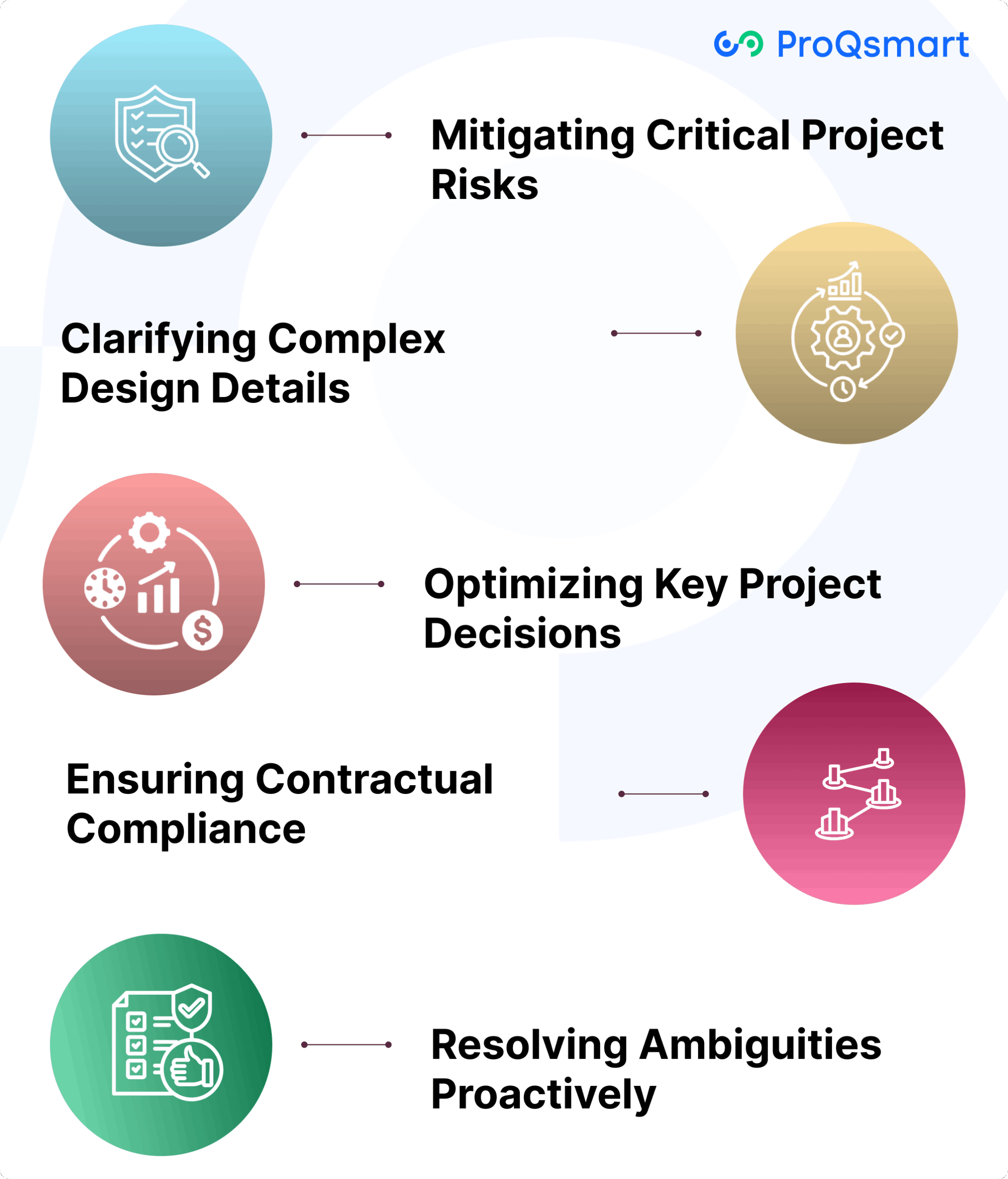
RFIs are an essential tool in helping teams mitigate risk and successfully deliver construction projects. They help your team understand the work beforehand. Furthermore, they help maintain the progress of work and mitigate possible problems before they occur.
When used correctly, RFIs allow movement to dissect complicated designs and clarify each phase to everyone involved. They give a way for builders, designers, and owners to talk and fix gaps in the plans that might slow things down or cause mix-ups.
Mitigating Critical Project Risks
By allowing for more detailed review and correction, RFIs prevent small errors from snowballing into expensive issues down the line. Asking the right questions up front helps teams discover missing elements in drawings or specifications.
This proactive method avoids schedule slippage and removes the necessity for costly rework. For example, if a plan doesn’t show how pipes should fit through a wall, an RFI can get the answer before the wall is built.
Clarifying Complex Design Details
Most projects get to a point where plans drawings just leave too much up to interpretation. RFIs help remove ambiguity from these fuzzy areas.
When a contractor spots a detail that doesn’t add up, they send an RFI to the architect for a straight answer. Preventing these delays, reworking, and confusion is the key to maintaining progress.
RFIs help build trust, because every answer to an RFI is distributed to the entire team.
Optimizing Key Project Decisions
RFIs create better decisions by introducing knowledge and information at the right time and place, when people need it most. If a builder finds a better way to set up HVAC units, an RFI lets them ask if this new method works.
Quick responses help keep the whole team moving without delay. This fast-tracking approach results in improved overall project performance, with every decision made with the benefit of the best possible choice.
Ensuring Contractual Compliance
RFIs help teams adhere to contracts. RFIs ensure that every decision made is in accordance with the established contract. They provide an opportunity to review specs, clarify language, and communicate revisions so all parties are on the same page.
Providing that level of detail prevents legal battles later on and ensures equitable work opportunities for everyone involved. Documenting RFIs provides documentation to demonstrate how vital questions were resolved.
Resolving Ambiguities Proactively
Projects regularly run into trouble spots where nobody knows what the roadmap is supposed to entail. RFIs allow field teams to receive clear answers prior to the start of work ensuring they are not guessing.
This practice of questioning and communicating supercharges the entire project team. It significantly reduces the potential for costly errors and allows all parties to complete their work correctly the first time.


Key Elements of an RFI
In construction, a Request for Information (RFI) constitutes a formal stick. It helps to clarify project needs and details and is invaluable for moving forward with the right decision. A properly constructed RFI document provides definition and discipline to a big undertaking by establishing the framework for essential details to be conveyed among all parties.
Well-defined RFI processes allow project teams to maintain project momentum, reduce rework, and avoid budget overruns. Using a standardized RFI form with sequential numbers gives every team member a clear way to track and handle each request.
Essential Project Context
Providing project context in an RFI establishes the background of the issue you are asking about. It provides context on the site, design, or overall project coordination that has brought about the request. If a contractor has a question regarding a wall finish, they need to refer to the appropriate plan sheet.
They can point out the site boundaries or even spot any conflicts. This context lets the designer or engineer see the bigger picture, so they answer in a way that fits the job. Providing as much information as possible in the beginning avoids a flurry of follow-up emails and ensures things don’t get held up in the process.
Potential Proposed Solutions
Provide enough detail that you give the team the opportunity to be creative and collaborate. A contractor could offer multiple solutions for a detail they find vague, accelerating the architect’s approval. That’s nearly one-tenth of the median RFI response time.
The median is roughly 9.7 days and has the potential to reduce the $1,080 average cost of review. Providing choices allows the RFI recipient to provide a definite, quick response, which keeps the project moving on time.
Critical Response Deadline
Establishing a deadline for RFI responses helps ensure that there is momentum behind the work and provides adequate notice to all parties involved. Deadlines create urgency, safeguard quality, and force realism on what stakeholders should expect.
When all parties are aware of the schedule, the design team is better able to schedule work and eliminate costly delays.
Sender and Recipient Information
Each RFI must identify the sender and recipient with complete contact information. This allows you to maintain a public record of who asked what and when, ensuring nothing falls through the cracks.
Good record-keeping enhances transparency and collaboration, allowing stakeholders or team members to easily find out what issues have been responded to or are still outstanding.
Navigating the RFI Workflow
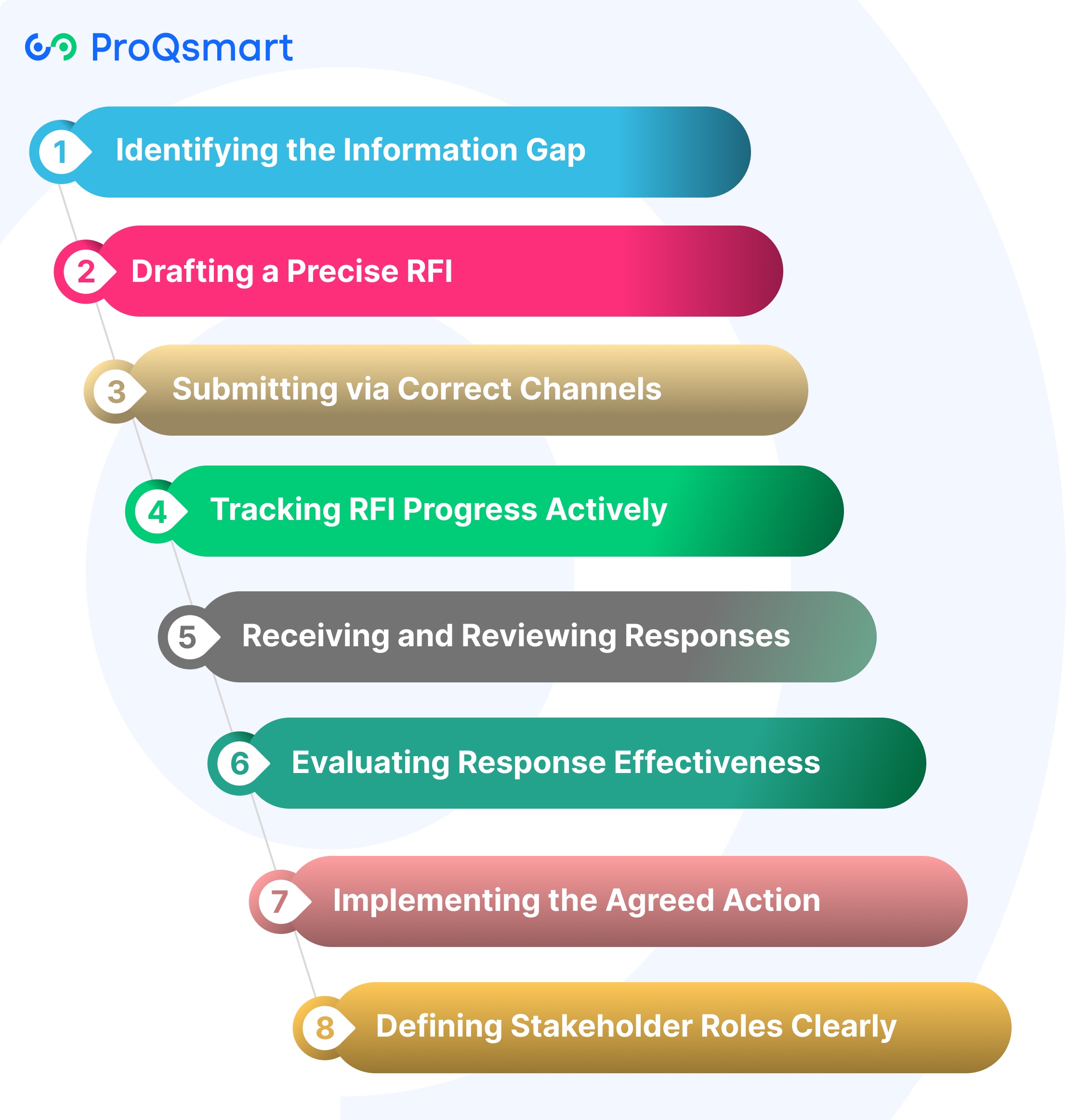
In construction project management, a thoughtfully-managed construction RFI process can serve as both a defense and offense, laying a foundation for project clarity and speed. Teams that establish a clear RFI workflow from the outset experience fewer project delays, a lower rate of costly rework, and more efficient construction sites.
1. Identifying the Information Gap
It all begins with a detailed review of plans, specifications and contracts. Sometimes dramaturgical gaps emerge as a result of absence or contradiction, or when an argument becomes divisive.
Project teams that identify these gaps early in the process are able to maintain projects moving to advertise on time and avoid unnecessary cost overruns. When a site crew checks drawings and finds mismatched piping specs, they flag it right away instead of waiting for a problem.
This type of preemptive check prevents costly delays from becoming too prolonged and keeps the cost of projects down.
2. Drafting a Precise RFI
A strong RFI spells out what’s missing, using a set format: RFI number, title, submit date, who’s asking, who answers, and a clear ask. This helps to ensure that everyone is aligned and it eliminates a lot of the potential for second-guessing.
A concise, properly formatted RFI gives the design team a chance to provide a speedy, high-value response on the first request.
3. Submitting via Correct Channels
RFIs should follow established channels—usually electronic—to maintain momentum and ensure that the appropriate parties review them as quickly as possible. Utilizing construction management software like ProQsmart allows teams to monitor each stage of the construction RFI process, issue warnings, and maintain a complete audit trail.
4. Tracking RFI Progress Actively
A good team logs each and every construction RFI, follows up on status, and continues to seek a solid answer. Maintaining an RFI log allows construction project management teams to better prepare for weeklies, establish realistic project schedules, and ultimately demonstrate true progress to clients.
5. Receiving and Reviewing Responses
Once a reply is received, it is reviewed quickly by teams and if appropriate the RFI can be quickly closed out upon receipt of the satisfactory reply. Otherwise, they send a request for more information.
Fast-paced Q&A prevents minor problems from escalating.
6. Evaluating Response Effectiveness
Teams confirm that the resolution answered the gap in the construction RFI process. In the meantime, it’s months of notes taken for next time, allowing each new RFI construction document to become stronger and more agile.
7. Implementing the Agreed Action
Once the issue is resolved, teams can immediately get to work on the answer using construction management software. They pass new info to subs and crews, update drawings, and make changes in the field to keep the construction project rolling.
8. Defining Stakeholder Roles Clearly
Evangelizing clear roles—who starts the RFI, who answers the RFI, who reviews the RFI—leads to less finger-pointing and quicker responses.
On large jobs, a project manager, his main job using ProQsmart, is to ensure RFIs don’t languish.
Avoid Common RFI Pitfalls
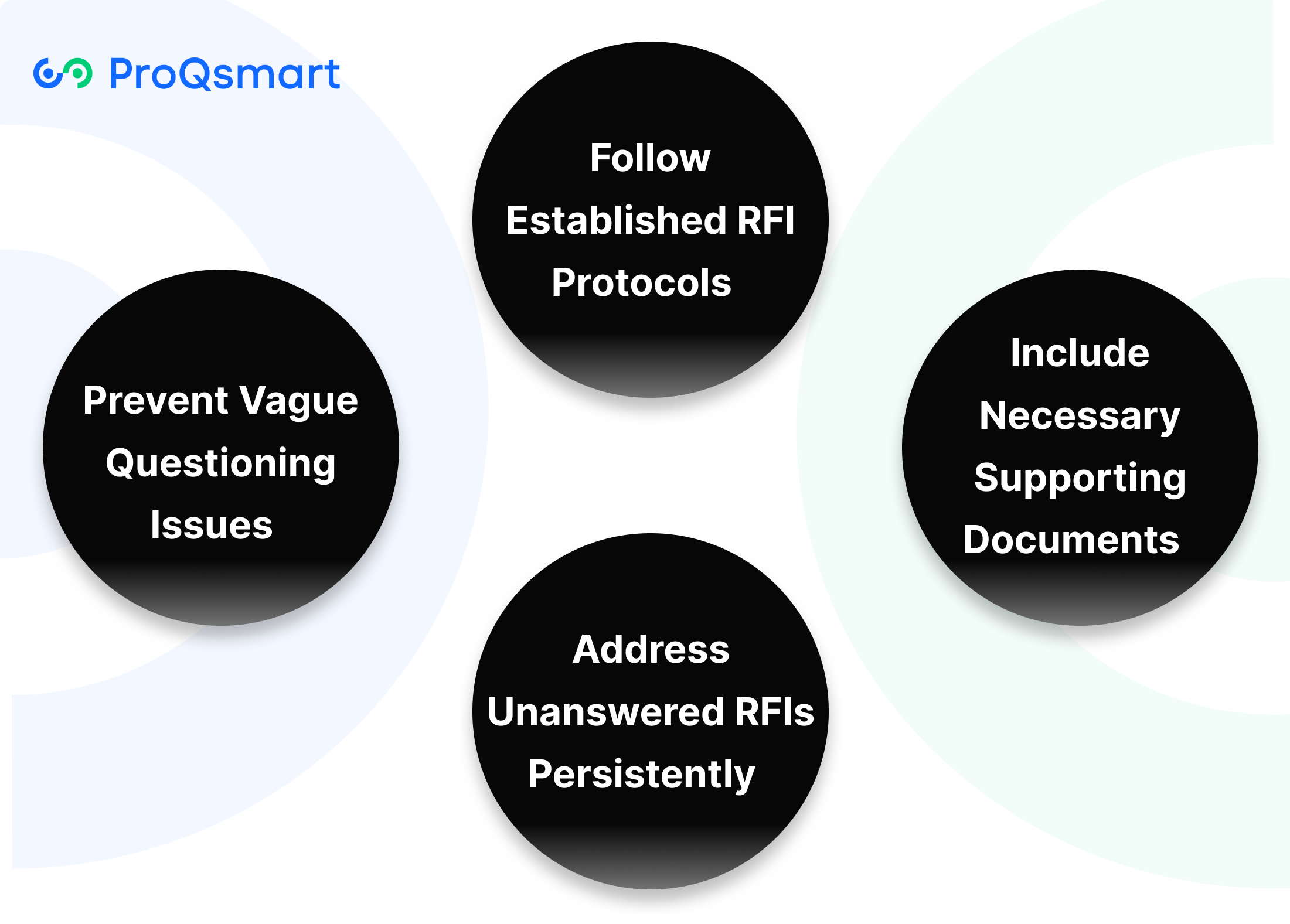
In construction, RFIs have become an important lifeline for project teams. They do provide an opportunity to clarify design or scope issues before these problems bog down the advancement. Avoidable errors can snag the most seasoned teams.
When they require a structured format for RFIs, it helps avoid confusion and maintains the flow of the process. Concise, exacting instructions pave the way to effortless RFI vendor submissions. For example, a contractor requesting “additional information regarding the HVAC system” would receive a response that is incredibly unclear.
Requesting “please verify the make and model of the rooftop air handler” removes all doubt. With ProQsmart’s AI-driven workflows, you can pre-qualify candidates in a fraction of the time. This can confuse vendors, cause delays, and add unnecessary guesswork into the process.
Prevent Vague Questioning Issues
To cut through the ambiguity, teams increase clarity when they solicit straightforward, well-defined questions in their RFIs. Vague requests allow wiggle room to err and delay response time.
For example, “clarification wall specs” is less informative than “provide the fire rating for the east stairwell partition.” A simpler, clearer RFI language results in less back-and-forth, less time-wasting, and more surety of answers provided.
Follow Established RFI Protocols
When all parties adhere to defined RFI processes, the project operates more efficiently. Having standard steps helps with uniformity, keeps everyone honest, and reduces the opportunity for misinterpretation.
Refocusing all parties—owners, designers, and contractors—on these simple steps helps everyone stay on track and the project stays on course. Using a dashboard or other reporting tool further enables you to monitor each RFI from inception to resolution.
Include Necessary Supporting Documents
Providing appropriate backup – drawings, specifications, or photos – with each RFI takes them to the next level and ensures everyone is on the same page. Attachments provide relevant information and context, ensuring answers are tailored to that question.
This practice ensures responses are in good shape and right on point.
Address Unanswered RFIs Persistently
Nonresponse rates can reach 35% in some areas. Ongoing, direct follow-up, frequent check-ins, and firm deadlines ensure that everything stays on the radar.
Accountability and continued outreach push projects forward.
Boost RFI Management with Technology
The most productive construction sites today depend on leveraging the right technology. Other upcoming construction projects will need immediate answers today. Digital technologies streamline the construction RFI process and allow teams to avoid costly delays.
Streamline Submission and Tracking Processes
Digital tools, including cloud-based platforms, allow all stakeholders to file and track RFIs from the field using a smartphone or laptop. This translates to reduced administrative burden and quicker turnaround times.
With real-time updates, project managers can easily view and approve RFIs as they come to fruition. With a few taps, they’re able to flag the appropriate team for swift resolution. This prevents things from getting stalled and reduces the burden of administrative work.
Real-time access to RFI info gives every stakeholder the full picture, so no one misses key details. When more efficient workflows are in place, there are fewer costly mistakes made, and answers are available in real-time.
Enhance Team Collaboration Instantly
Cloud-based collaboration tools allow construction crews, designers, and owners to exchange information on one centralized platform. Since messages and files move fast, everyone is always on the same page.
Seeing RFI progress on a visible board allows teams to identify bottlenecks quickly and find solutions to eliminate them. This interactive exchange answers questions and facilitates the RFI closure process with minimal turnaround time.
Leverage RFI Data Analytics
Teams really get the competitive edge when they analyze RFI trends with robust reporting tools. Identifying recurring problems or bottlenecks enables project leaders to change tactics moving forward to improve performance.
Because data-driven reviews can flag any areas where additional information is required, teams can begin to group RFIs and reduce unnecessary back-and-forth. This ongoing, real-time feedback ensures that projects are continuously improved from start to finish.
Integrate with Existing PM Software
RFI tools are even more effective when they integrate with larger project management (PM) systems. Integration brings together all project documentation, RFIs, and updates in a central location.
That enhances transparency among decision-makers and allows anyone to quickly see what’s been completed and what work is still outstanding. Having everything managed on one, single, unified platform helps to minimize the clutter, allowing teams to spend less time searching for important information.
Explore AI-Powered RFI Solutions
With AI, you can automatically read and sort RFIs—and flag lower priority RFIs for a faster response. Platforms including ProQsmart utilize artificial intelligence to accelerate the bidding process, track suppliers, and stay within budget.
With automated workflows and smart alerts, it’s less guesswork and more action. AI-driven insights identify costly patterns, so teams address problems before they become costly.
Combined with improved compliance, real-time tracking, and streamlined subcontractor management, full-service ProQsmart gives user companies everything they need right at their fingertips.
Conclusion
RFIs are therefore at the center of effective communication on a construction job site. They address unidentified scope, mitigate risk, and maintain communication across teams. Better RFI management means no wasteful miscommunication and no delay in construction. Teams that develop an effective RFI routine identify problems early and correct them before construction is delayed.
Equipped with the right tools, such as smart RFI solution, everyone can send, track, and close RFIs in real time. This means less time waiting and more time building. Smart teams use RFIs as a way to keep the whole crew on the same page, from start to finish. Interested in learning more, or ready to get started? Learn more about ProQsmart and schedule your demo today!
FAQs
What does RFI stand for in construction?
In construction terms, the RFI process, or Request for Information, is a formalized procedure where project teams seek clarification on construction documents or project specifications.
Why are RFIs important in construction projects?
RFIs play a crucial role in the construction RFI process by addressing uncertainties early, thus preventing costly mistakes or delays in the construction project. This ensures that every team member is aligned with the project objectives, enhancing quality and safety throughout the construction management.
What should be included in a well-written RFI?
A quality construction RFI includes an easy-to-understand question, a reference to the relevant project documents with a specific section highlighted, and the requester’s contact information. Utilizing construction management software like ProQsmart can help standardize and track RFIs effectively.
How does the RFI workflow usually operate?
The construction RFI process begins with submission, moving through review by the responsible party, and onto a documented response. ProQsmart can automate these steps to ensure faster, more accurate project communication.
How do I implement CapEx software successfully?
Start by evaluating your needs and choosing a solution like ProQsmart for streamlined capex management. Train your team, integrate it with existing systems, and monitor usage for effective capex planning.
What are common pitfalls to avoid with RFIs?
Don’t ask dubious questions, unreferenced bluster, or late ruminations. Using ProQsmart simplifies the construction RFI process, bridging you across these pitfalls by standardizing the procedures.
How can technology improve RFI management?
Digital platforms, such as ProQsmart, streamline the construction RFI process, enhancing RFI tracking and collaboration while minimizing costly errors. This includes publicly available, real-time coverage, as well as a searchable database for project stakeholders to find project information and maintain transparency.